


Share This Article
Have you ever been to Slovakia? There’s a big chance you’ve explored the Tatras or the Spiš region—but what about visiting the capital? Bratislava is an interesting destination for a weekend trip, and thanks to its great location, you can visit up to three European capitals within just a few dozen kilometers during one longer journey!
Bratislava had been on my mind for some time, mainly because I had heard the usual opinions from many people—that it’s bland and unattractive. Quite a few cities have been “recommended” to me in this way, so I felt even more compelled to check it out myself—especially since such opinions have never really proven true in my experience. Of course, everything depends on expectations, but in my opinion, Bratislava doesn’t have many areas where it can truly show off!
Location and Transport
Bratislava, as you probably know, is the capital of Slovakia and is located in the southern part of the country. It’s quite a unique city because it borders two other countries—Austria and Hungary. If you plan to travel to Bratislava by car, the most recommended route goes through the Czech Republic and takes over six hours (around 550 km). Keep in mind that if you drive through the Czech Republic and use highways, you need to purchase a vignette.
You can also reach Bratislava by plane or bus, but we chose to travel by train. There are no direct connections from Kielce, so we first went to Kraków, where we had a transfer before continuing our journey. The train from Kraków to Bratislava takes about six hours. Interestingly, when traveling from Poland to Slovakia, you actually ride a Hungarian train through the Czech Republic. Why Hungarian? Because its final destination is Budapest. In Bohumín, some of the train cars were detached and continued on to Prague.
The train was comfortable, although with temperatures exceeding 30°C outside, the air conditioning was working at its limits. A definite advantage was the ticket price—by purchasing it on promotion, we managed to pay less than 50 PLN for a one-way ticket.
Bratislava and Its History – A Brief Overview
Bratislava boasts a rich history and, thanks to its location along two important trade routes—the Amber Road connecting the Mediterranean Sea with the Baltic Sea, and the Danube Route—played a significant role in this part of Europe. Evidence of settlement in the area dates back much earlier (for example, the Roman military camp Gerulata).
The city was granted municipal rights as early as 1291 and developed from a settlement beneath the castle that still towers over today’s skyline. In the following centuries, Bratislava continued to grow, and the establishment of Academia Istropolitana in 1467 strengthened its international importance. In 1536, Bratislava became the capital of Hungary. It was here that the Hungarian Diet convened and where kings were crowned (a total of 18 kings and 11 queens consort).
Over the centuries, Bratislava experienced both prosperous and difficult periods, with the reign of Maria Theresa being one of its golden ages. At the beginning of the 20th century, the city became a cradle of the Slovak National Movement, and later the political, economic, and cultural center of the country. For many years, Bratislava served as the capital of Slovakia within Czechoslovakia, and since 1993—after the country’s division—it has remained the capital of independent Slovakia. Interestingly, the name Bratislava was officially adopted only in 1919.
What to Eat in Bratislava?
Before I show you the places I recommend in Bratislava, let’s start strong—with food! Slovak cuisine shares some similarities with Czech cuisine, but in Bratislava, due to its location, you’ll also notice influences from Austrian and Hungarian cooking.
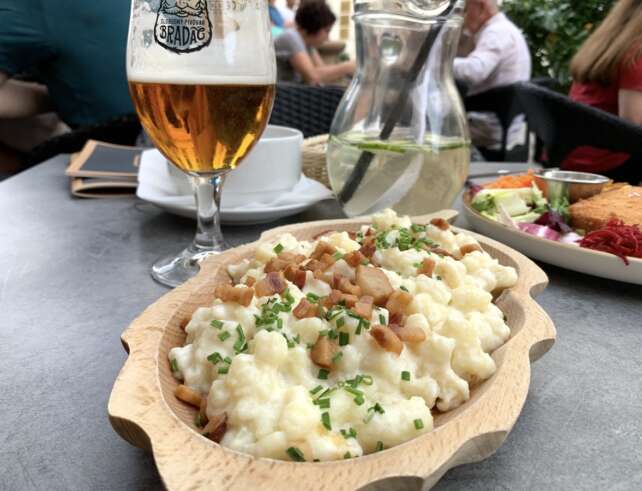
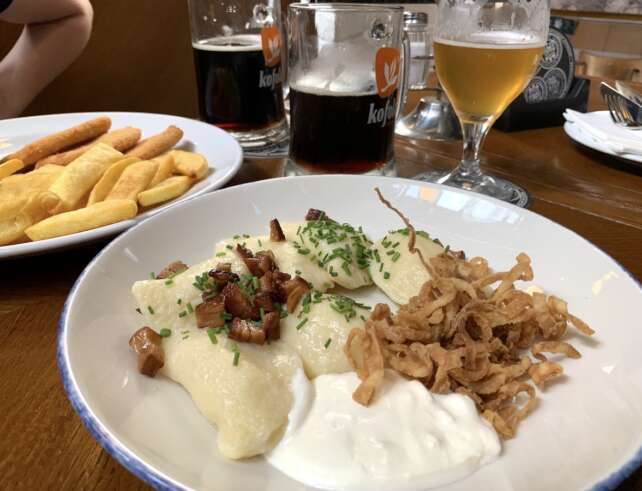
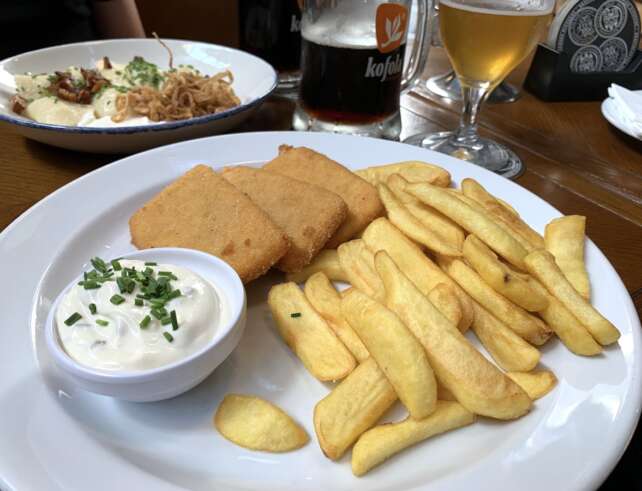
Of course, Slovak cuisine is best known for dishes like bryndza dumplings (bryndzové halušky), pierogi, fried cheese, schnitzel, goulash, Kofola, beer, mead, and many more! In the city, you’ll also easily find restaurants serving international cuisine, offering dishes from all over the world. If you’re not a fan of experimenting (although I still encourage you to try!), you’ll have no trouble finding pizza, burgers, or ramen. The Old Town is also full of ice cream parlors—perfect for cooling down while sightseeing.
Bratislava actively promotes its local cuisine! Restaurants in the Old Town use sidewalk signs to encourage visitors to try traditional dishes. On one hand, it’s a classic tourist-oriented strategy—since there are plenty of visitors in the city—but on the other, it’s great to see strong awareness and appreciation of local culinary traditions.
We visited two places, and both met our expectations. The first was Bratislavský Meštiansky Pivovar located at Dunajská 21. It’s outside the Old Town, but definitely worth the walk—the food is tasty and the beer is excellent. Right next to the brewery, you can also spot a few interesting murals.
The second place we visited for lunch was LOCLUB – Food & Music at Ventúrska 5. We had a great meal in both places. For two main courses with drinks, you can expect to pay around 30–40 euros.
Souvenirs from Bratislava
Of course, there are no more valuable souvenirs than experiences and memories—but many of us simply like to bring something back from a trip. Looking at such items later helps us recall those pleasant moments, and we often buy something for family or friends as well.
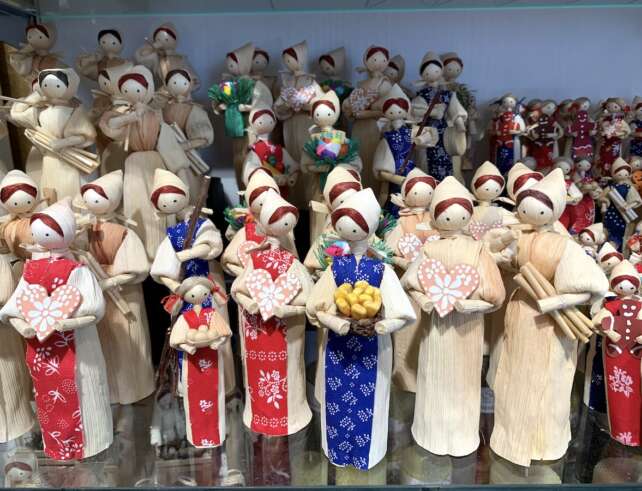
In Bratislava, you’ll of course find classic souvenirs such as magnets (around 3–4 euros), postcards, tote bags, and many others. In souvenir shops, you can also often find ceramic and wooden products, as well as traditional regional dolls made from… corn husks. On the shelves, you’ll also come across items featuring Krtek (the Mole) (T-shirts, plush toys, socks), although their prices can sometimes be surprisingly high.
For me, one of the best ways to find good souvenirs is simply to visit a grocery store—and it’s no different in Slovakia. You can stock up on local sweets, snacks, and other treats there. On the streets of Bratislava, you’ll also come across “cheese vending machines,” where you can buy local cheeses. Be sure to try Slovak wines as well—they can be a very pleasant surprise (a small part of the Tokaj wine region is located within Slovakia).
Bratislava Card
During our stay, we used the Bratislava Card, which we received from the city of Bratislava. We opted for the 48-hour version, which included free entry to many attractions, discounts, and also served as a public transport ticket. The card costs 32 euros, and with intensive sightseeing, it really pays off.
With the card, you get free entry to the castle, the Town Hall, Michael’s Gate, the Natural History Museum, and many other places. You’re also entitled to join a guided city walking tour free of charge. You can find more details about the card on the official website.
We didn’t use a physical card—instead, we installed a dedicated app, which made using it very convenient.
What to See in Bratislava?
Bratislava is an interesting city where you’ll easily find enough attractions to fill an entire weekend! Depending on your interests, you can focus on historical landmarks, museums, green spaces, or other forms of sightseeing.
Bratislava Castle
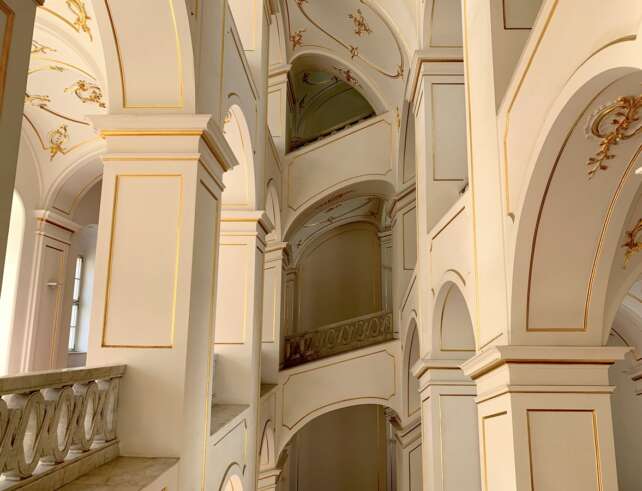
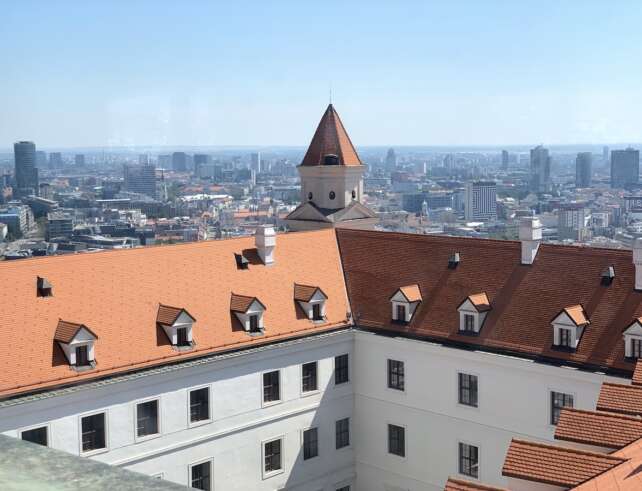
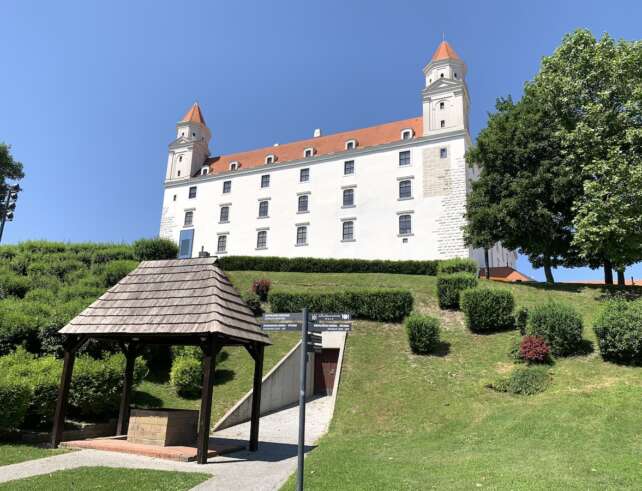
Bratislava Castle towers over the city and can be seen from many places—not just from the Old Town. It is the most valuable historical monument in the city and is open to visitors. Walking there from the Old Town involves a bit of an uphill climb, but both the castle itself and the views from it are absolutely worth the effort! The hill, rising 85 meters above the Danube, is a key destination for most tourists visiting the city.
The first fortified settlement at this location dates back to the 9th century, and that’s also when the first written mentions of Bratislava appeared. In the 11th century, a stone palace was built on the hill and later underwent numerous reconstructions. Different stages of its development even had their own names—Sigismund, Pálffy, and Theresian phases, among others. During the reign of Maria Theresa, some fortifications were removed, and the building was expanded for residential purposes.
In 1811, a fire broke out and destroyed the castle. The ruins remained abandoned for over 150 years, as reconstruction was only completed in 1968. It then became the seat of the Slovak National Museum. The complex includes both the castle and its gardens, which I’ll mention shortly. While walking around the castle or looking from some of its windows, you can spot old foundations—they belong to a Great Moravian basilica that once stood nearby.
If you’re walking from the city center, be prepared for about a 15-minute steep uphill walk. From what I saw, it’s also possible to reach the castle by vehicle, but from the opposite side of the Old Town (via Palisády Street). You can take trolleybus lines 44 or 47 to the Hrad or Zámocká stops. We chose to walk from the Old Town side—it’s a pleasant but slightly demanding climb with beautiful views.
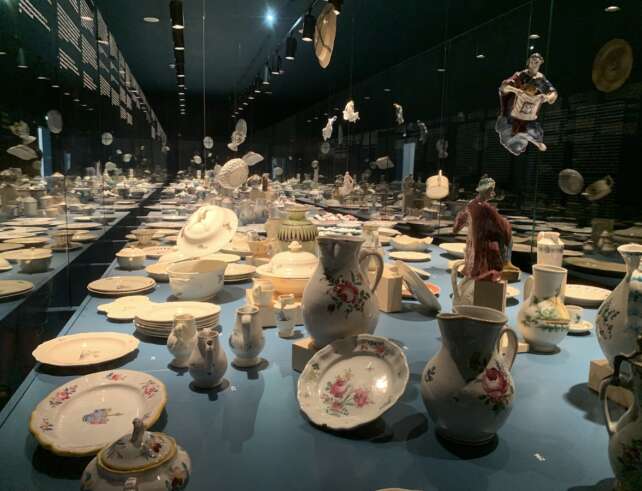
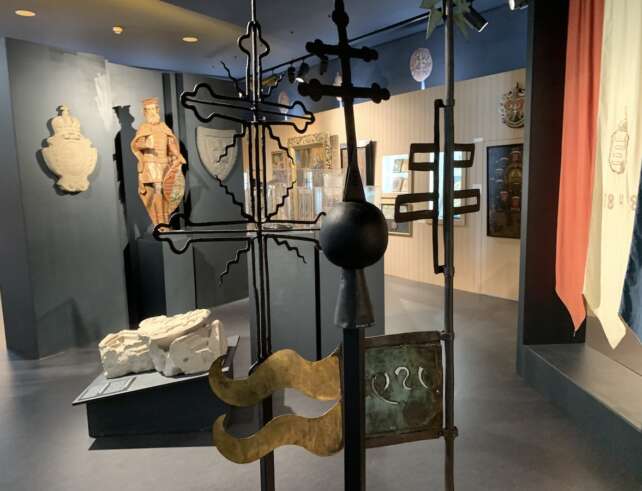
Inside, you’ll find exhibitions on various topics. You can visit the castle treasury, admire paintings and sculptures, and explore displays such as the one dedicated to the Double Cross—the symbol of Slovakia. One of the castle towers is also open to visitors and offers unforgettable panoramic views.
With the Bratislava Card, entry to the castle is free. A regular ticket (including museum exhibitions and the treasury) costs 14 euros, and a reduced ticket costs 7 euros. If you want to explore all exhibitions in detail, plan at least 3–4 hours. The museum is open daily except Tuesdays, from 10:00 to 18:00, with the last entry at 17:00. The castle grounds are open daily from 8:00 to 22:00.
Castle Gardens
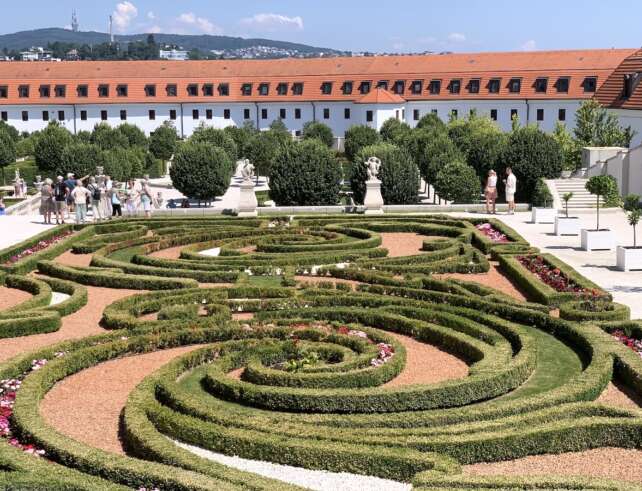
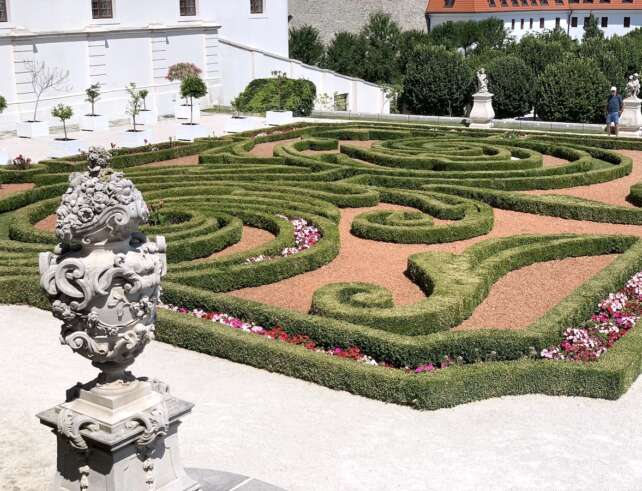
An inseparable part of Bratislava Castle are its gardens. Entry is free, and it is definitely worth visiting them—they are truly impressive. One of the most significant periods in the castle’s history was the reign of Maria Theresa, who carried out a Baroque reconstruction of the complex. In the second half of the 18th century, a French-style garden was created on the northern terrace, inspired by the gardens of Schönbrunn Palace in Vienna.
The garden is open daily from 9:00 AM. Closing hours vary depending on the season. In January, February, November, and October, it closes at 4:00 PM; in March and October at 5:00 PM; in April and September at 6:00 PM; in May and August at 8:00 PM; and in June and July, it remains open until 9:00 PM.
Town Hall and Museum
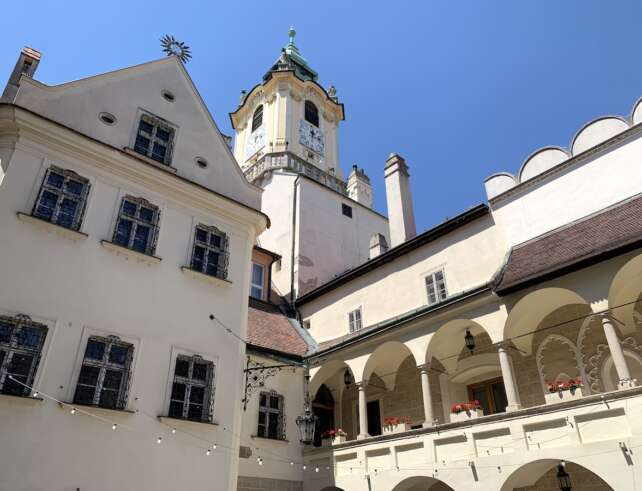
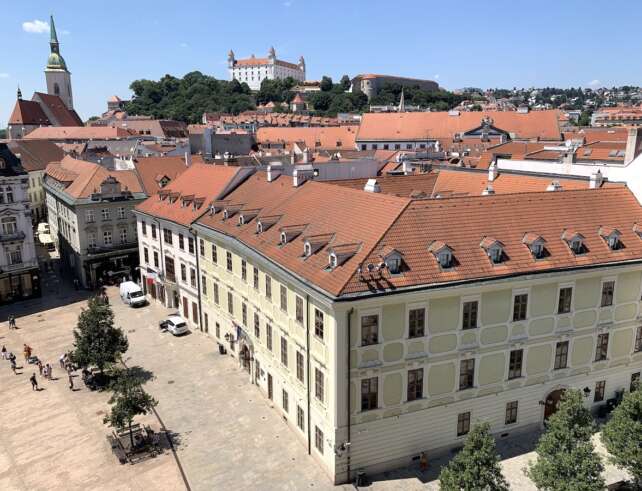
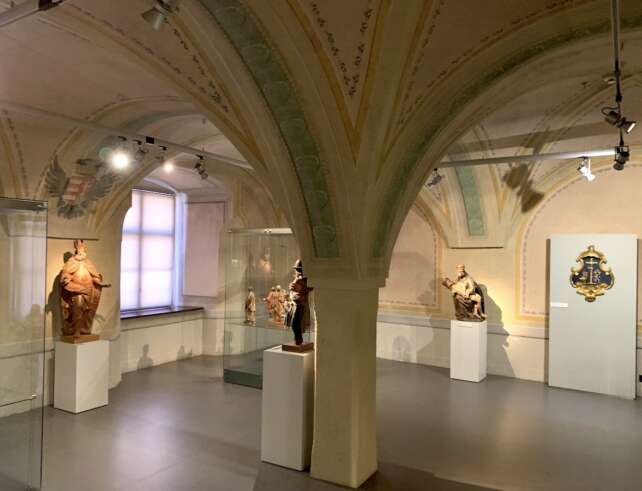
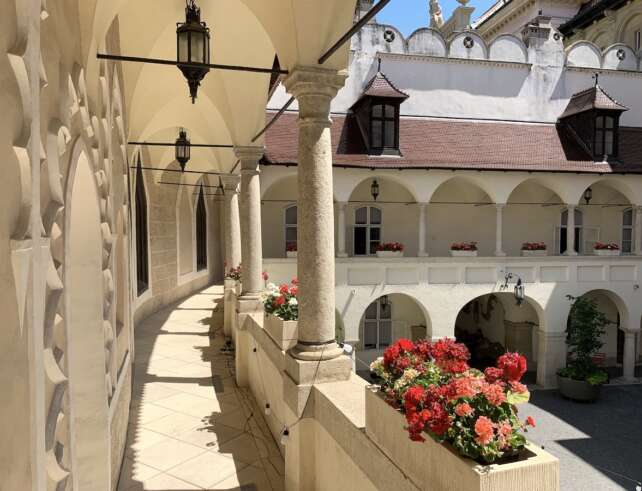
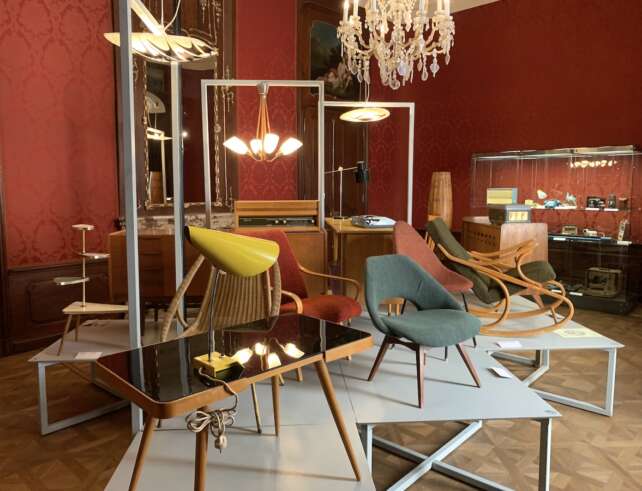
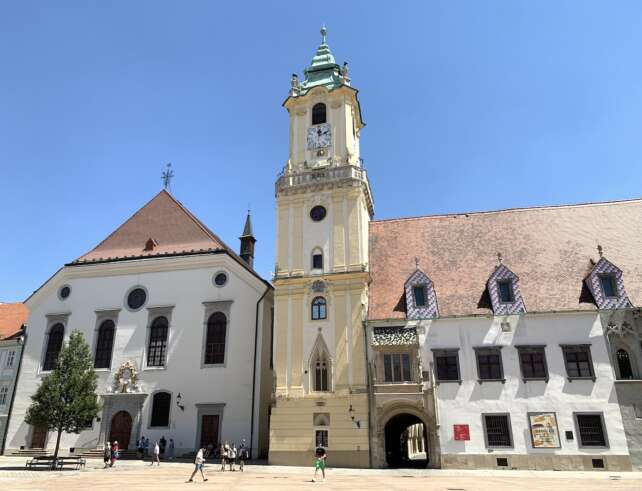
Right next to the main square of Bratislava stands the Old Town Hall in Bratislava. It is a remarkable building, and the museum housed inside is definitely worth a visit. The museum presents the history of the city in an engaging way and is the oldest institution of its kind in all of Slovakia. It also showcases the original rooms of the town hall, along with information about their functions and history. The exhibitions are very diverse—you’ll find elements related to history, sacred art, the communist era, and much more.
The Town Hall itself was used from the 11th to the 15th century and is the oldest building of this type in Slovakia. Today, the city authorities are based in the Primate’s Palace. Over the centuries, the Old Town Hall was expanded, resulting in the unique architectural form we can admire today. Essentially, it was created by combining the House of Jacob and the House of Pater. In the past, it also served as a prison, archive, mint, and arsenal.
In addition to its fascinating exhibitions, the tower of the Old Town Hall is also an उत्कृष्ट viewpoint. From its balcony, you can see the entire Old Town of Bratislava at a glance, with Bratislava Castle rising in the background. Seeing the city from above offers a completely different perspective and leaves a strong impression.
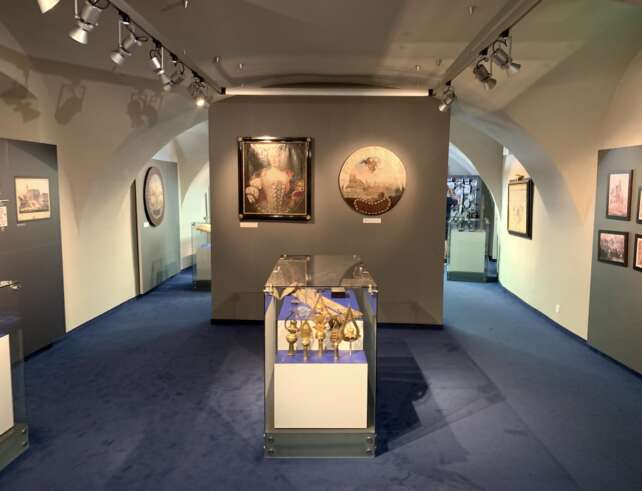
Michael’s Gate
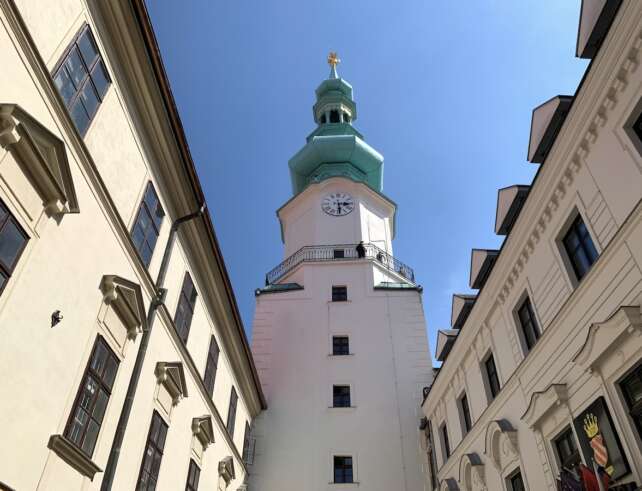
Michael’s Gate is one of the historic city gates of the Old Town. It is located in its northern part and houses a museum. Tickets can be purchased or collected (for holders of the Bratislava Card) at the nearby Pharmacy Museum, situated just behind the gate.
It is the only preserved city gate of the Slovak capital. The structure is 51 meters high, and at its top stands an 18th-century statue of Archangel Michael. The entire building was most likely constructed at the beginning of the 14th century. By climbing to the top of the tower, you can learn a great deal about Bratislava’s fortifications and city walls. However, in my opinion, the most interesting feature is the viewing terrace located on the sixth level.
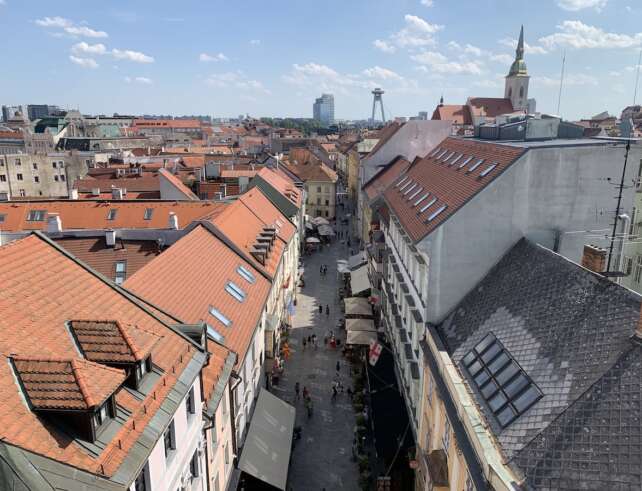
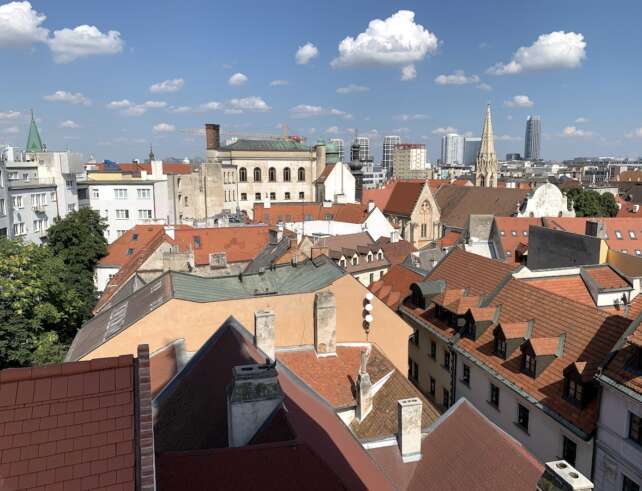
Bratislava offers several places from which you can admire the city from above. Alongside the UFO Tower (which I’ll mention shortly), the terraces near the castle and the Town Hall tower, Michael’s Gate provides another excellent opportunity to see the city from a bird’s-eye view. From the top, you can clearly see the representative Michalská Street, as well as the previously mentioned UFO Tower and many other landmarks of the Old Town.
Main Square – Hlavné námestie
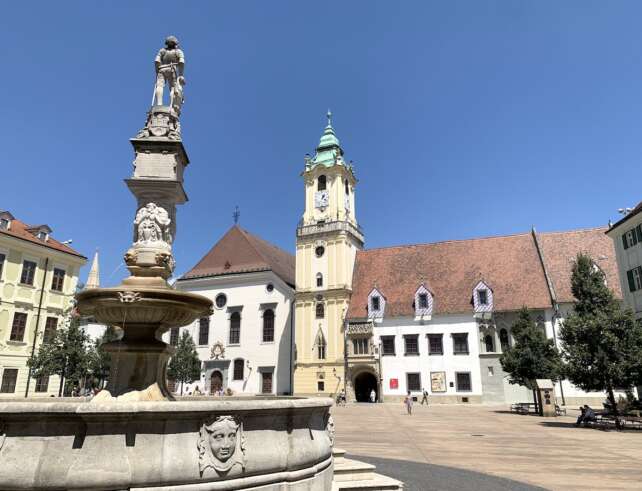
Hlavné námestie is the main square of Bratislava. Many people refer to it as the market square due to the role it has historically played. It is located in the heart of the Old Town and borders Františkánske námestie as well as Sedlárska and Radničná streets.
This is a very popular spot among tourists and a favorite location for photographers. In the center of the square stands the Roland Fountain, while one of the surrounding walls is occupied by the Old Town Hall Bratislava.
Near a bench on the square, you’ll also find a metal statue of a Napoleonic soldier, who eagerly poses for photos with visitors.
Čumil the Sewer Worker
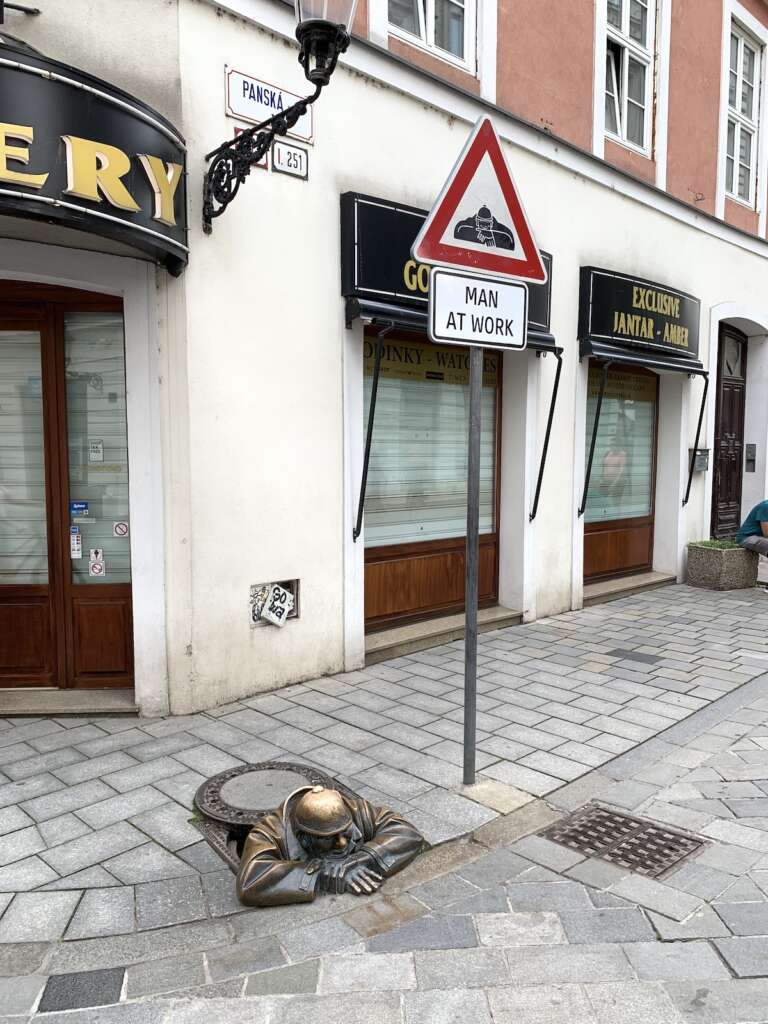
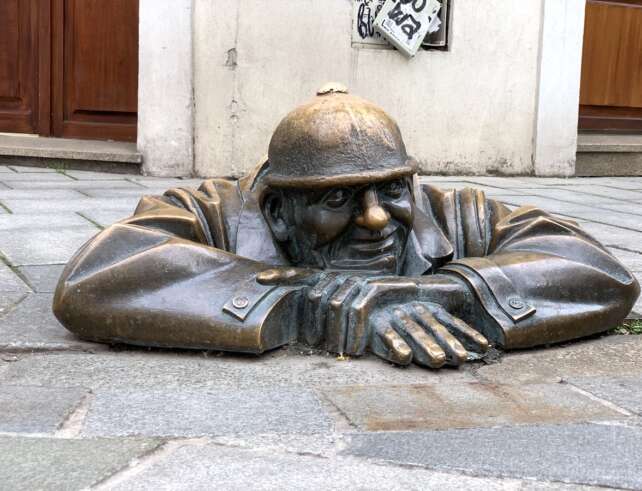
One of the symbols of Bratislava is the figure of the friendly sewer worker Čumil. He is located at the corner of Panská Street and Rybárska brána in the Old Town of Bratislava (on the route between Hviezdoslav Square and the Old Market Square). The author of this sculpture is Viktor Hulík. It appeared on the streets of Bratislava in 1997 and immediately gained the affection of tourists.
The origin of this sculpture is interesting. The author himself claims that Čumil does not commemorate any historical figure or event, and the sole purpose of its creation was to bring life to Bratislava’s Old Town. It certainly worked, as it is now one of the most photographed objects in the Slovak capital. The figure of the sewer worker emerges from a manhole, so you need to lower your gaze to street level to see him. For those who tend to look a bit higher, since 1999 there has also been a sign installed showing a man at work, featuring the image of the sewer worker.
While walking through the streets of the Old Town, you will find several other figures with which you can take photos.
Cathedral
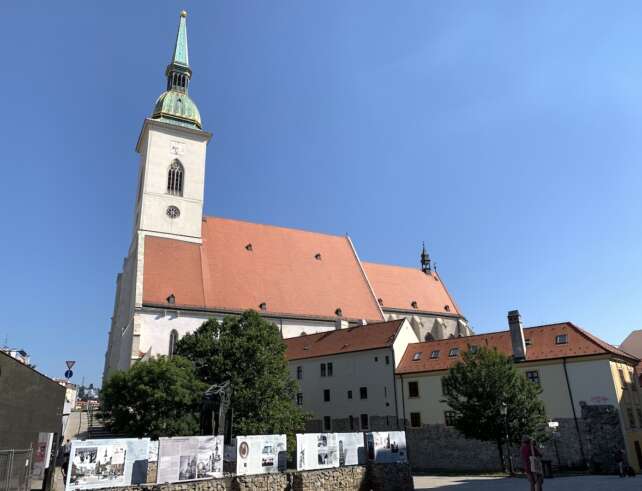
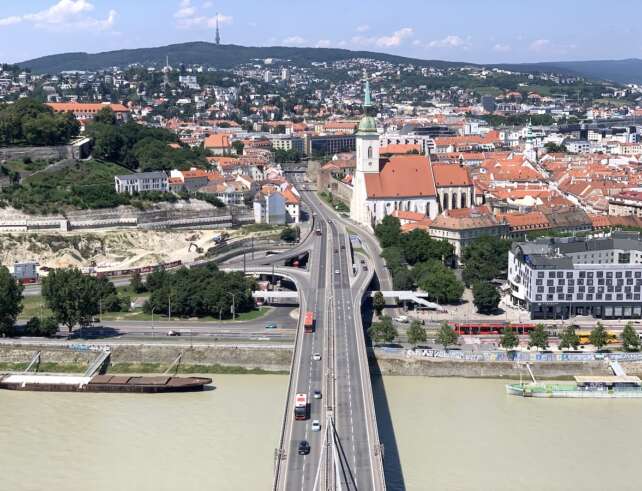
Bratislava’s cathedral, the Church of St. Martin (Katedrála svätého Martina), is located on the edge of the Old Town at Rudnayovo Square 1. It is a large building that is hard to miss, and to reach it you should head toward the SNP Bridge (Slovak National Uprising Bridge).
It was completed in the 14th century, when Pope Innocent III allowed the chapter to be moved from the castle. The cathedral was built on the site of an earlier Romanesque church. Over the years, it has been rebuilt many times, and its current appearance is largely the result of 19th-century works. In the past, the church tower was part of the city’s fortifications.
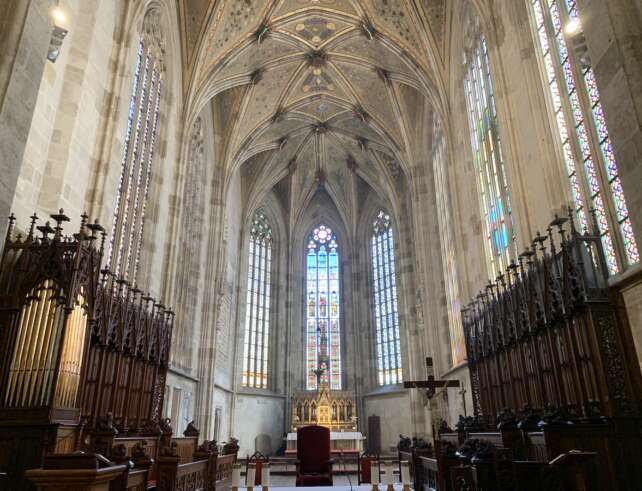
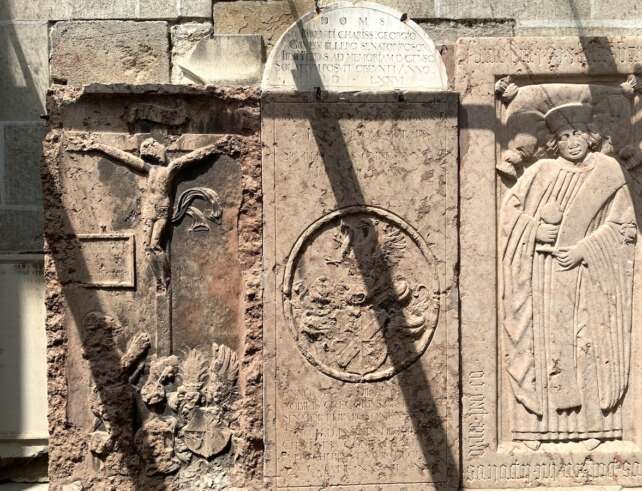
The interior of the cathedral is designed in the Neo-Gothic style. The oldest chapel in the church is the Chapel of St. Joseph, originating from the Romanesque structure. Among those buried in the cathedral is Sophia of Bavaria, Queen of Bohemia and Hungary, as well as eight Hungarian primates.
The cathedral was also the site of many coronation ceremonies of Hungarian monarchs—eighteen in total! Among those crowned here were Maximilian II, Maria Theresa, and Ferdinand V, who was the last person crowned in the cathedral.
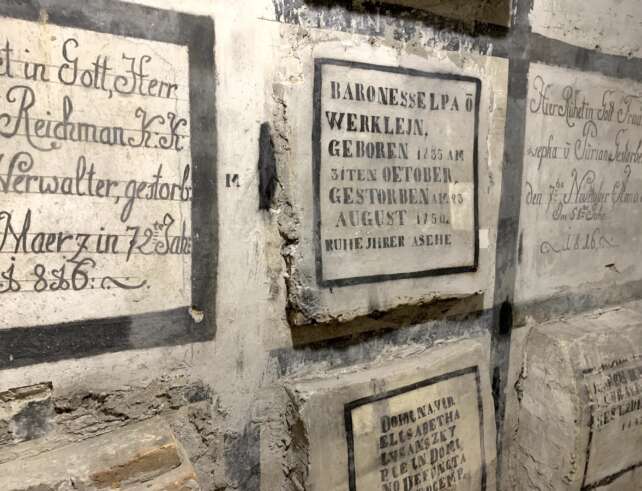
With the Bratislava Card, you can enter the crypts for free. The entrance is located on the left side of the church (facing the main altar) in St. Anne’s Chapel. Steep stairs lead underground, where the temperature provides a pleasant contrast to the heat outside. You enter independently, and motion sensors activate the lights in successive corridors. The crypts are not large, and some of the graves are labeled.
It is worth noting that the cathedral is open to tourists from 9:00 to 11:30 and from 13:00 to 16:00. The break is due to mass being held during that time.
UFO Tower
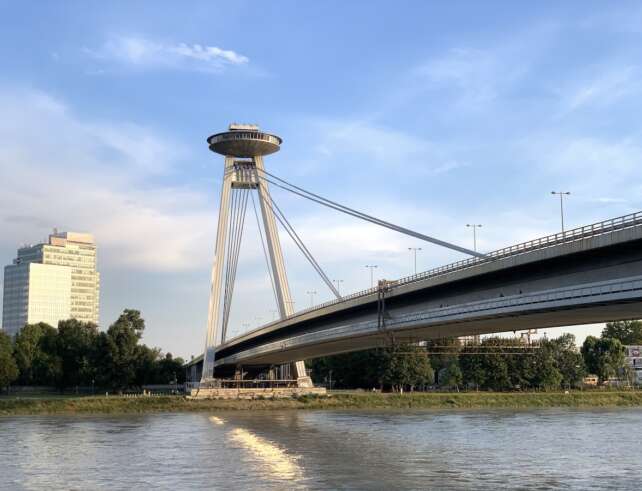
The idea of building a bridge with a unique observation tower was conceived in 1967, and five years later the tower was opened. In 2001, it was recognized as the Slovak Structure of the Century. In 2003, the entire structure and its interior underwent renovation.
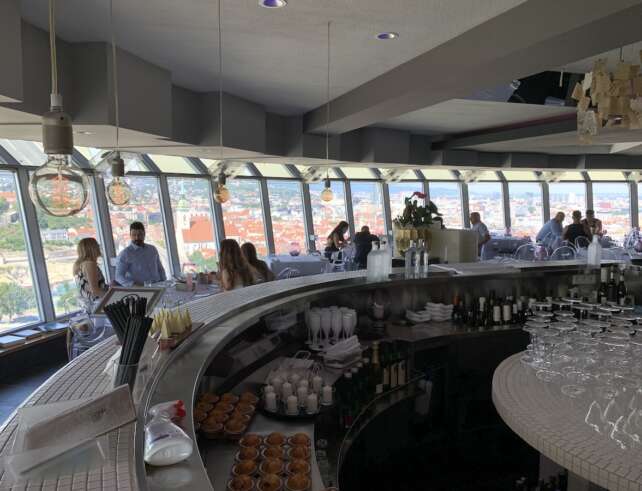
The UFO Tower is 95 meters tall, and the observation platform is located at the very top (also at 95 meters). About ten meters below, there is a restaurant and bar with seating for 130 people, offering incredible views of the city. The top of the UFO tower features 60 windows, and it can be accessed by elevator. To reach the observation deck, you need to climb a short flight of stairs.
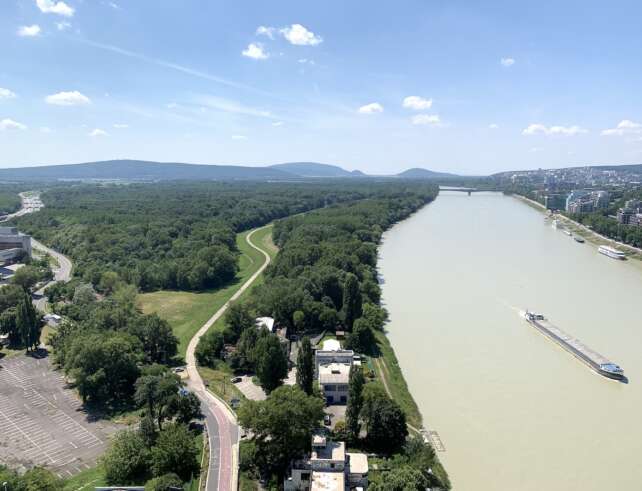
What awaits you at the top? Bratislava in all its glory! In addition to stunning views of the castle and Old Town, you can also see the Danube River, the industrial parts of the city, housing estates, and green areas. It is definitely worth experiencing this view.
With the Bratislava Card, you get a 20% discount on the ticket, which costs between €9.90 and €11.90 depending on the day and time.
Transport Museum in Bratislava
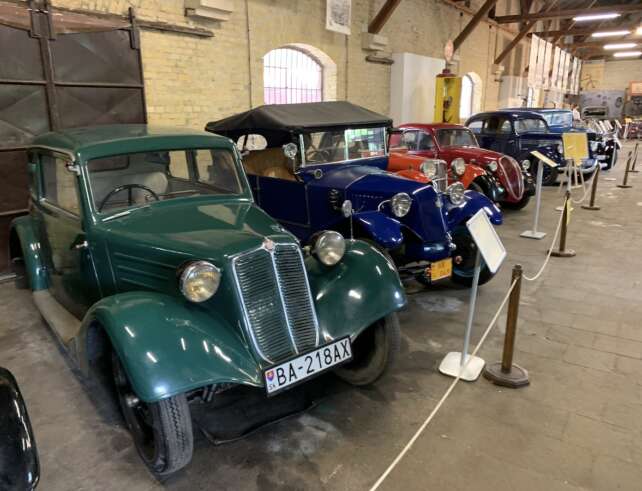
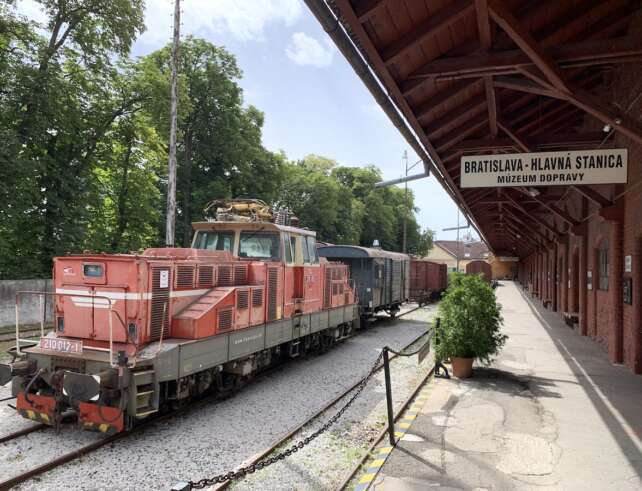
The last point of our stay in Bratislava, before having a Kofola at the station and catching our train, was a visit to the Transport Museum. It is located near the main railway station, so we saved it for the return journey. Its exact address is Šancová 6419/1B. If you plan to visit, set aside about 1–2 hours to explore the entire exhibition. Interestingly, the museum is located on the grounds of the first Bratislava steam railway station from the 19th century.
The exhibition is divided into several sections. In addition to the indoor displays, you can also see cars and trains outdoors. The indoor exhibition is organized thematically, covering rail, water, and road transport. Some of the vehicles date back to the interwar period.
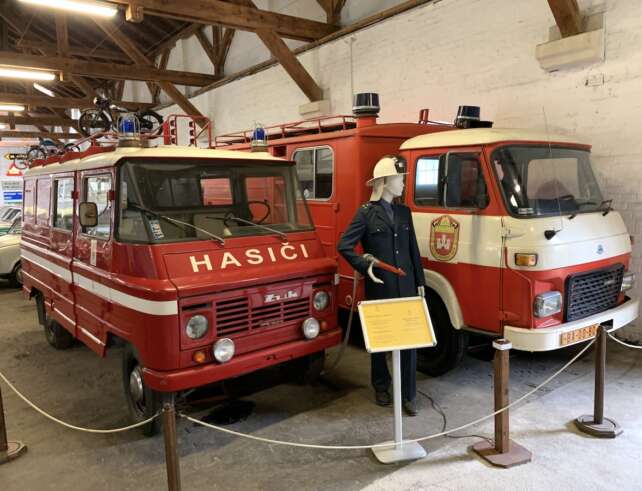
The sections on railway and water transport are interesting, but to be honest, we liked the old cars the most. You will find Škoda, Tatra, and other models there, including several prototypes. There are also two Polish highlights: a Polski Fiat and a Żuk painted in the colors of the Slovak fire brigade.
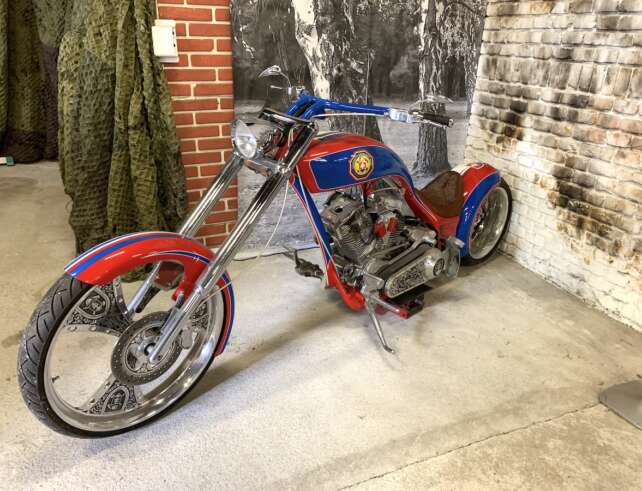
A fun fact is that the museum features an original motorcycle built in the Orange County Choppers workshop, known from Discovery Channel shows.
The Blue Church
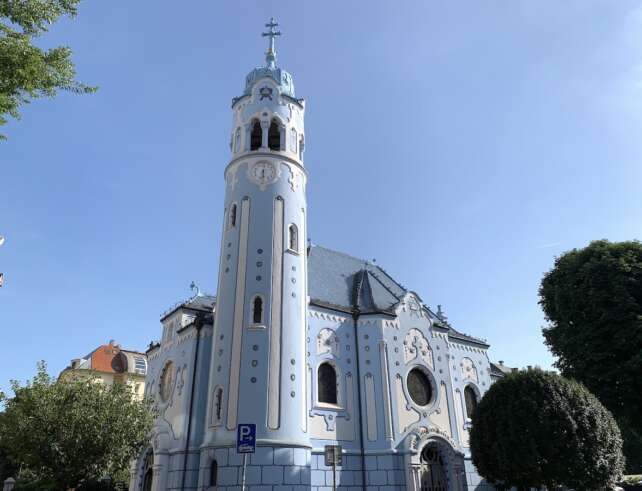
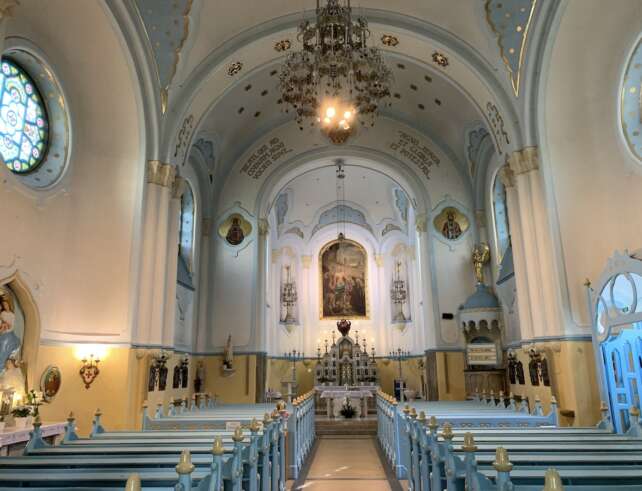
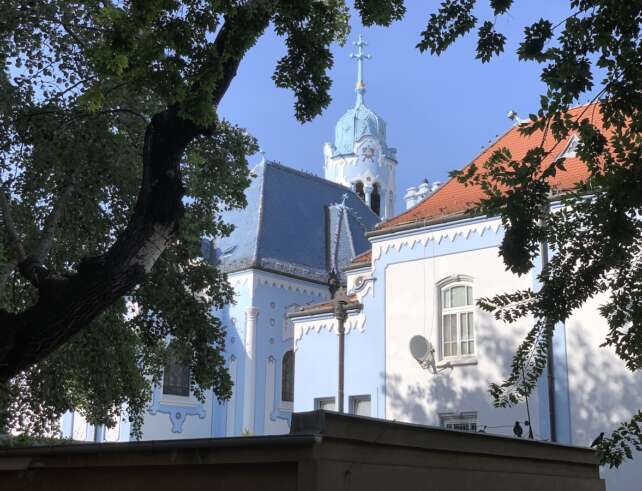
While walking through Bratislava, we came across signs pointing toward the Blue Church. We followed them and—no surprise—arrived at a blue church. It is the Church of St. Elizabeth (Kostol svätej Alžbety, also known as the Blue Church), an interesting example of Art Nouveau architecture.
It is a Roman Catholic church built in 1913. Its patron was Emperor Franz Joseph I, and it was dedicated to St. Elizabeth of Hungary, who was born at Bratislava Castle. The architect was Ödön Lechner, and the blue color can be found both outside and inside.
Clock Museum
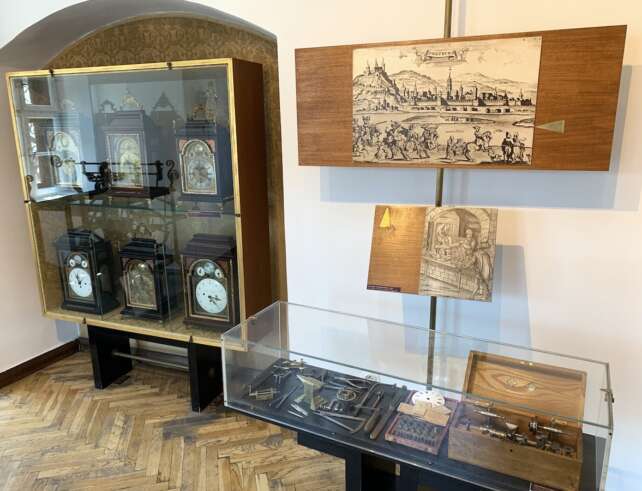
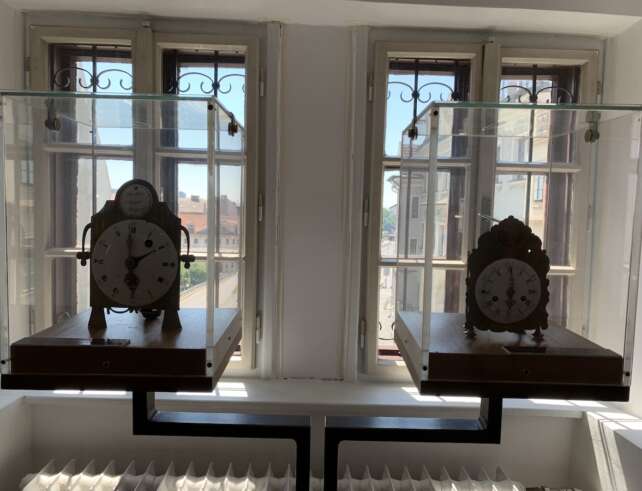
Another museum included for free with the Bratislava Card was the Clock Museum. Located near the cathedral, it is not very large, but you will find many interesting clocks there. It occupies three rooms of a small townhouse. The clocks come from different periods and represent various types. If you need a short break after visiting the castle, this is a good place to relax—plan about 30 minutes for the visit.
Murals in Bratislava
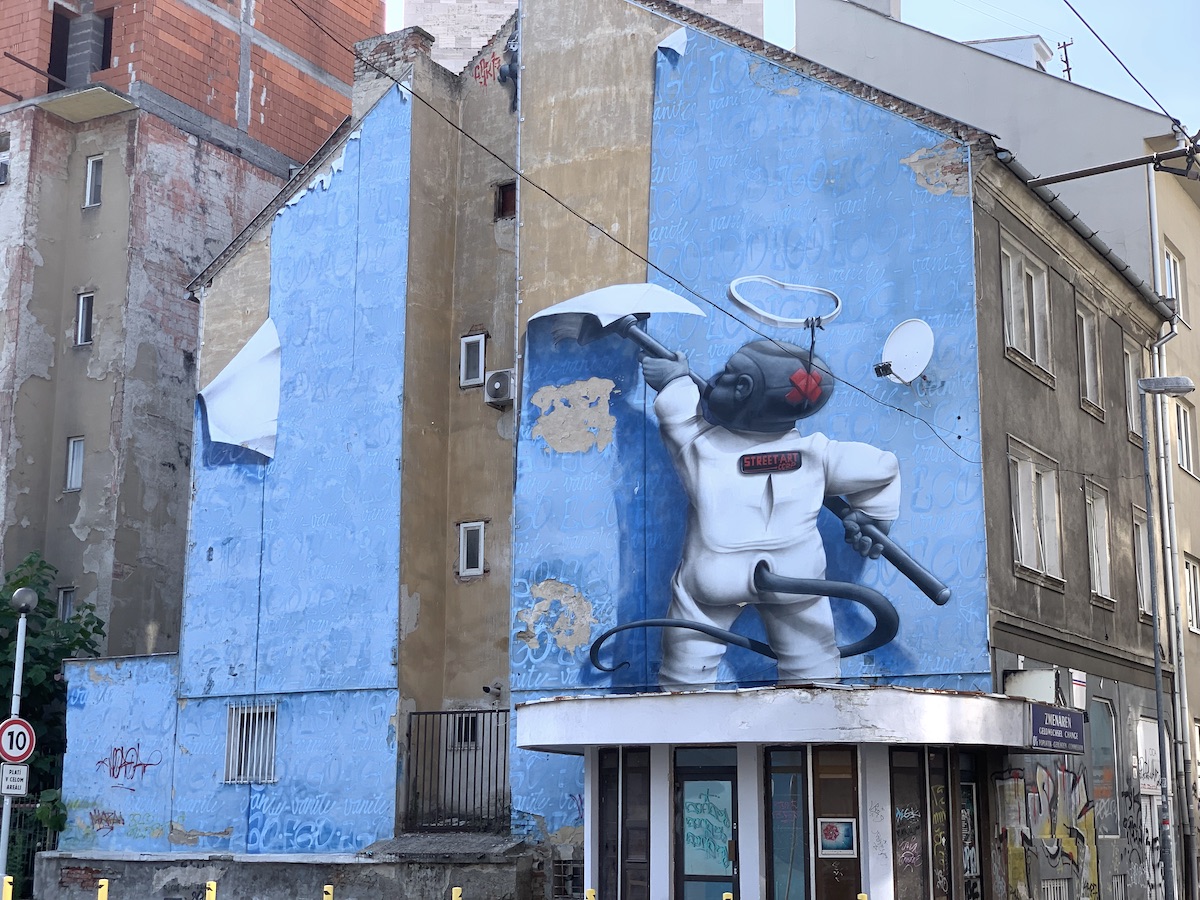
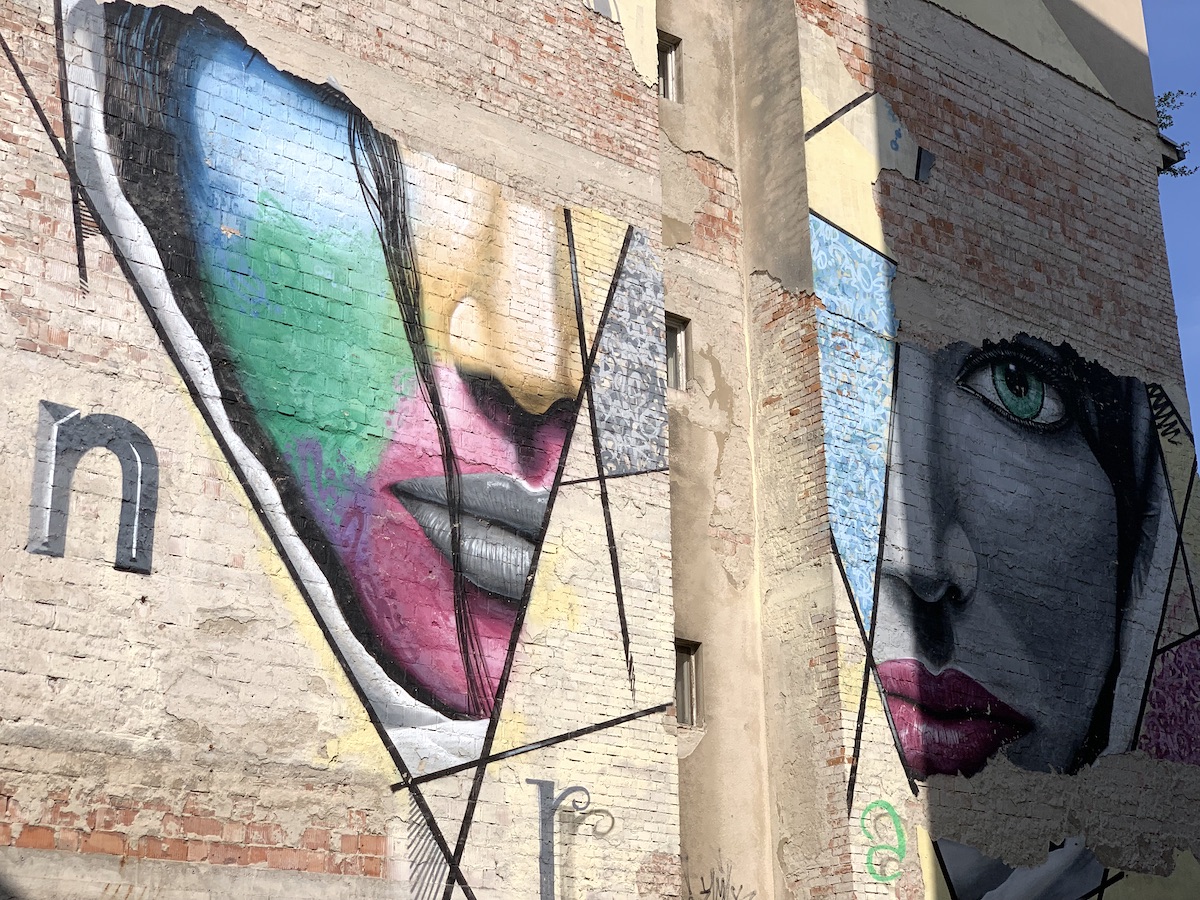
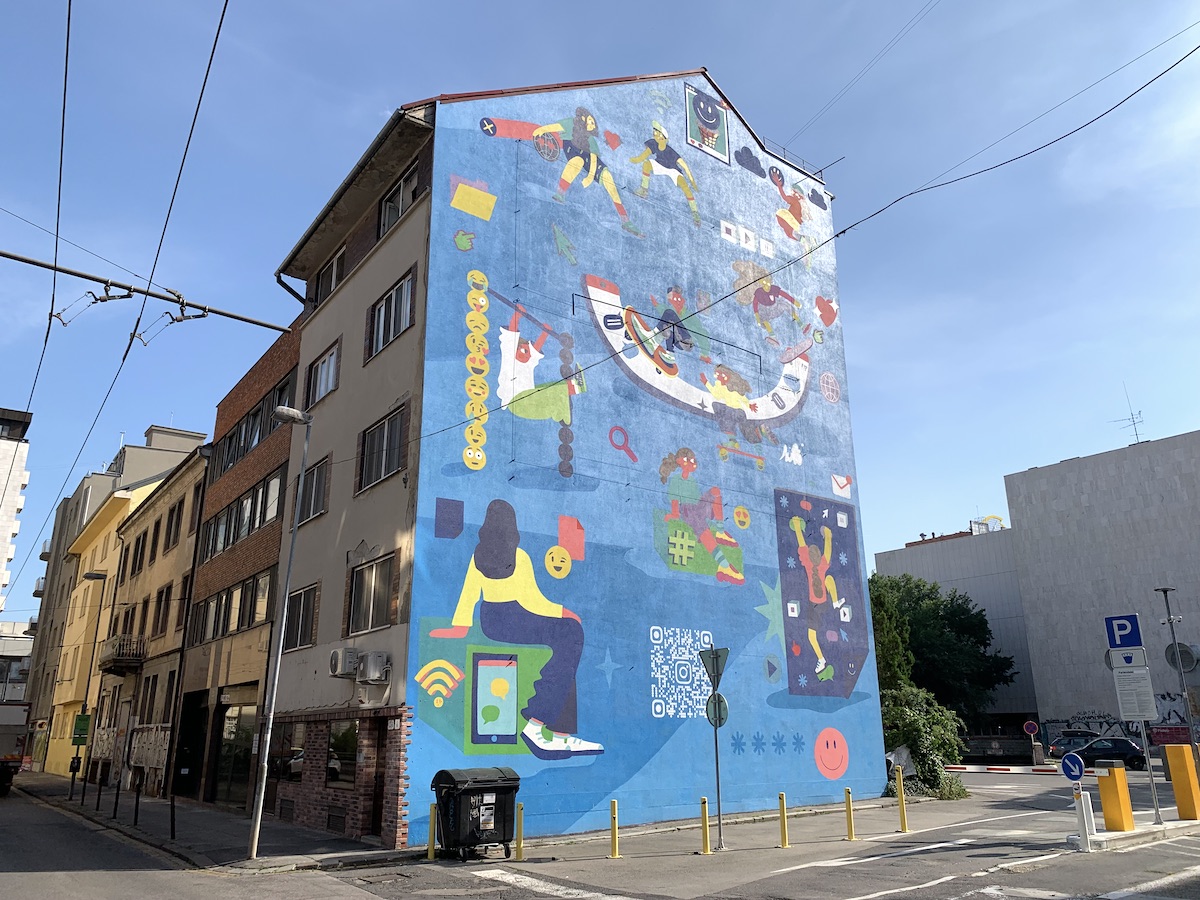
We didn’t find many murals in Bratislava, but examples of street art can be seen throughout the city. A small concentration is around Rajská Street and its surroundings. You will find several large and interesting murals there. There is little information about them online. The first one in the photo is by the Cart1one collective, while the second shows a work by local artists Daor & Dano. We also saw a few other interesting pieces online, and while exploring the city, you will likely come across more—perhaps not always large, but still interesting forms of street art.
If you are planning trips focused on street art, consider Tirana—an article about murals in that city can also be found on the website.
Is Bratislava a Good Weekend Destination?
At the beginning, I wrote that Bratislava doesn’t have many areas to be ashamed of—and I will confirm that now! A small but charming Old Town, interesting museums, and good restaurants with tasty food make it a great plan for a weekend trip. During our stay, we didn’t encounter any problems, and we walked around both during the day and at night. We did come across quite a few bachelor and bachelorette parties, but they didn’t cause any discomfort. The only thing that might be noticeable for more sensitive visitors is the visible presence of homeless people, but in our case, it did not affect the overall impression of the city.
To sum up—if you want to spend a pleasant weekend sightseeing and enjoying good food, Bratislava is a great choice, whether for a full weekend stay or even just a one-day stop on the way somewhere else.